

Cricket has over 30 named fielding positions, though only 9 fielders (plus the wicketkeeper and bowler) take the field at once. Key positions include slip, gully, point, cover, mid-off, mid-on, mid-wicket, square leg, fine leg and third man. The captain places fielders anywhere on the field within the fielding laws. |
Cricket has more named fielding positions than any other major team sport. There are over 30 of them, and only 11 players take the field - one bowler, one wicketkeeper and nine fielders positioned across a ground that can be 150 metres from boundary to boundary. Where those nine fielders stand, and why, is one of the most tactically layered decisions in sport.
The positions are not fixed. A captain can place fielders anywhere on the field within the fielding restrictions, changing them delivery by delivery based on the bowler, the batsman, the match situation and the pitch. The cricket field positions described below represent the named locations from which a captain builds their field.
How is the cricket field divided into off-side and leg side?
All fielding positions are described relative to the batsman on strike. The field is split into two halves. The off-side is the side of the field in front of the batsman as they stand at the crease - for a right-handed batsman, that is to their right as they face the bowler. The leg side, also called the on side, is the opposite half. The entire field mirrors when a left-handed batsman is facing.
Positions are also described as in front of square or behind square, where square means level with the batsman's crease. A fielder in front of square on the off-side is closer to the bowler's end. A fielder behind square on the off-side is closer to the boundary behind the keeper. This system applies on both sides of the field and is the language captains and commentators use to describe field placements.
The field is further divided by distance from the batsman into three zones. Close catching positions sit within roughly 15 metres - the slip cordon, gully, short leg and silly point. The inner ring covers the 30-yard circle drawn around the pitch, where fielders stop singles and take catches from lofted shots. The outfield covers the ground between the inner ring and the rope, where fielders prevent fours and take high catches.
All cricket fielding positions: Quick reference
Position | Location | Purpose |
Wicketkeeper | Behind the stumps | Catches edges, executes stumpings only fielder allowed to wear gloves |
Slip(s) | Off-side, behind the batsman | Catches edges off the bat; numbered 1st, 2nd, 3rd outward from the keeper |
Gully | Off-side, wider than slips | Catches square edges; covers the gap between slips and point |
Leg slip | Leg side, behind the batsman | Mirror of slip; catches glances off pads from leg-spin or short bowling |
Leg gully | Leg side, wider than leg slip | Catches flicks and glances; used against sweep-heavy batsmen |
Short leg | Leg side, very close in front | Bat-pad catches against spin; fielder wears helmet and shin pads |
Silly point | Off-side, very close in front | Bat-pad catches on the off side; named for the apparent inadvisability of standing so close |
Point | Off-side, square to the batsman | Stops cuts and square drives; position of the best fielders in the game |
Cover | Off-side, in front of square | Stops cover drives; large area requiring exceptional fielding ability |
Extra cover | Off-side, straighter than cover | Secondary cover position; fills gap between cover and mid-off |
Mid-off | Off-side, straight, near bowler | Stops straight drives; backs up the bowler's end |
Mid-on | Leg side, straight, near bowler | Stops straight leg-side drives; backs up the keeper's end |
Mid-wicket | Leg side, between sq leg and mid-on | Intercepts pulls, sweeps and leg-side flicks |
Square leg | Leg side, square to the batsman | Either side of the square leg umpire; intercepts glances and sweeps |
Third man | Off-side, behind the keeper | Stops late cuts and edges past the slips; the third fielder historically needed to plug the gap |
Fine leg | Leg side, behind the keeper | Stops glances and deflections off pads; essential in all formats |
Long-off | Off-side, straight boundary | Behind mid-off; catches and stops lofted drives |
Long-on | Leg side, straight boundary | Behind mid-on; catches lofted leg-side drives |
Deep cover | Off-side, boundary | Boundary version of cover; also called sweeper cover |
Deep point | Off-side, square boundary | Stops powerful cuts; used against batsmen who square-cut frequently |
Deep mid-wicket | Leg side, boundary | Catching position for pull shots; high-traffic area in T20 cricket |
Deep square leg | Leg side, square boundary | Used against batsmen who sweep; essential against spin on slow pitches |
What is slip in cricket? Close catching positions explained
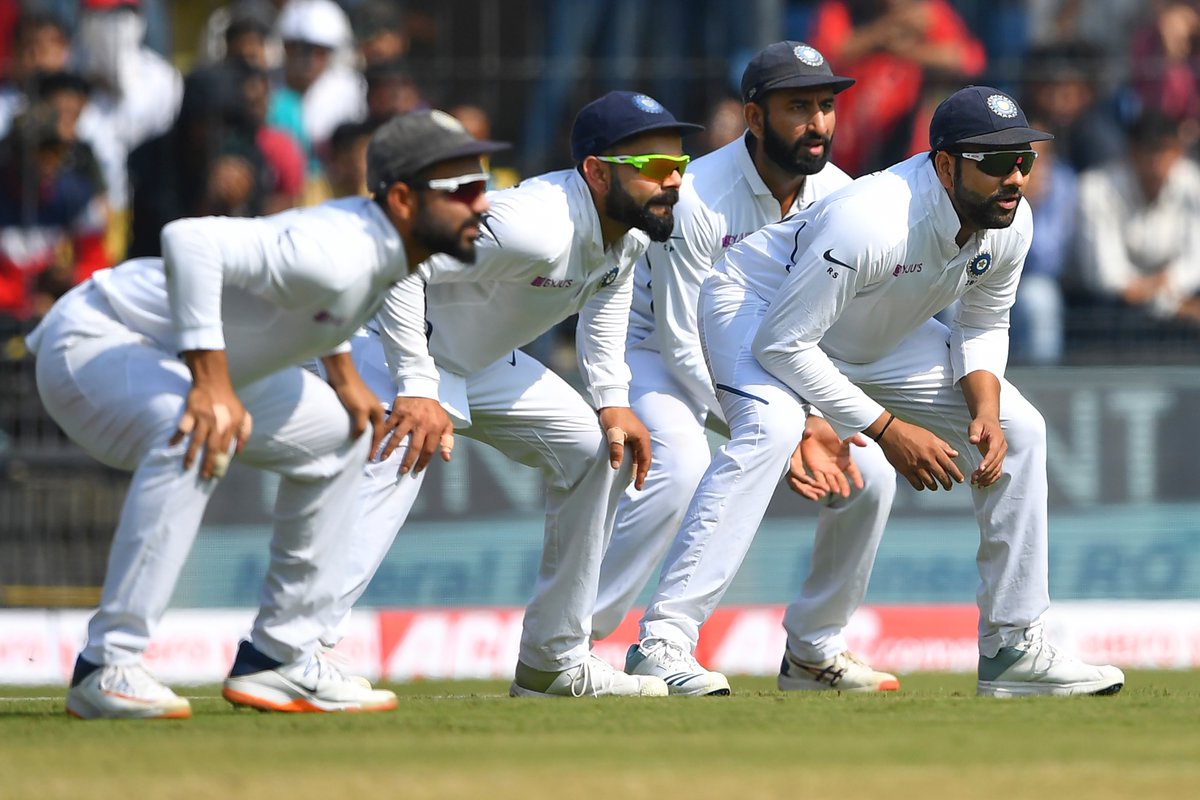
The slip cordon is the engine room of Test match bowling. Slip fielders stand to the off- side behind the wicketkeeper, in a diagonal line fanning outward - first slip is closest to the keeper, second slip next, third slip beyond that. When the ball swings or seams off the pitch, the edge is the most likely outcome of a good delivery. The slips are there to catch it.
Gully stands wider and squarer than the slips, covering the gap between the slip cordon and the point fielder. Gully catches tend to arrive quickly and at awkward angles, requiring fast hands and exceptional reflexes. The name comes from the narrow passage or channel the position covers between slips and point.
Short leg and silly point are the positions fielders least enjoy being assigned. Short leg stands on the leg side a few metres in front of the batsman, catching bat-pad deflections - balls that brush the edge of the bat and pad, or hit the pad and pop up gently. Silly point does the same job on the off-side. Both fielders wear helmets, shin guards and an abdominal guard, because a mis-hit from close range at international pace can cause serious injury. The 'silly' prefix reflects exactly that.
 Cricbuzz@cricbuzz
In #NameoftheGame S01E02, @SagarChawla90 speaks to @WasimJaffer14 and Ollie Rayner in a deep-dive into a more trivialized aspect of cricket - slip fielding.
Episode out, Thursday - 14.05.2020
 Cricbuzz@cricbuzz
In #NameoftheGame S01E02, @SagarChawla90 speaks to @WasimJaffer14 and Ollie Rayner in a deep-dive into a more trivialized aspect of cricket - slip fielding.
Episode out, Thursday - 14.05.2020
What is cover and point in cricket? Inner ring positions explained
Point stands square on the off-side, roughly level with the batsman's crease. It is traditionally where a captain places their best fielder - the position covers a large area, requires a strong and accurate throw and sees high volumes of cut and square drives. Jonty Rhodes redefined fielding standards in South African cricket across the 1990s and into the 2000s, making point and cover his domain. His run-outs became a benchmark for what elite fielding looked like.
Cover and extra cover fill the off-side gap between point and mid-off. Cover sits in the primary driving zone for a right-handed batsman. A weak cover fielder, one who cannot cut off the ball or throw flat to the keeper's end, concedes free runs. The best fielding teams consistently place athletic, accurate fielders in the cover region.
Mid-off and mid-on stand straight down the ground on either side of the pitch, close to the bowler, backing up the bowler's and keeper's ends on a straight drive. Mid-wicket and square leg fill the leg-side equivalent, covering the area through which a batsman sweeps or flicks off the pads.
What is fine leg and third man in cricket? Boundary positions explained
Third man and fine leg are the two most consistently used boundary positions across all formats. Third man sits on the off-side behind the slip cordon and wicketkeeper, stopping late cuts and edges that beat the slips. The name has a simple origin: slip and gully were the first two fielders placed behind square on the off side; the third fielder needed to cover the remaining gap became the third man. Fine leg is the leg-side equivalent, stopping glances and deflections off pads from balls bowled into the body.
In Test cricket, pace bowlers typically field at third man and fine leg during the overs between their spells - the positions see relatively little action, giving fast bowlers time to recover while keeping them at the right end to begin their next spell. In T20 cricket, both positions become premium catching locations as batsmen go for ramp shots and top edges trying to clear the infield.
Long-off and long-on sit on the straight boundaries behind mid-off and mid-on, as the primary catching positions for lofted drives and slog-sweeps. Deep mid-wicket and deep square leg patrol the leg-side boundary arc for pull shots and sweeps. Deep cover and deep point do the equivalent on the off-side.
What is cow corner in cricket?
Cow corner is one of cricket's most evocative position names and one of its least official. It refers to the deep leg-side area roughly between long-on and deep mid-wicket - the gap where a big left-handed swing or a slog from a right-hander tends to travel when the batsman connects through the line.
The name is thought to have originated in village cricket, where the area beyond the leg-side boundary was often a field where cows grazed. No captain officially sets a cow corner in a tactical briefing, but every cricket fan knows exactly where to look when the phrase is used.
The fly slip is a less common position sitting deeper than the regular slips, closer to the off-side boundary - used when a batsman consistently edges with enough power to beat a normal slip cordon. Short third man sits closer than a standard third man, used to cut off the finer deflection before it reaches the rope.
How many fielders are allowed outside the circle in cricket?
Two permanent fielding restrictions apply in all formats. A maximum of five fielders are allowed on the leg side at the instant of delivery. A maximum of two fielders are allowed behind square on the leg side. This restriction was introduced in 1957, primarily to prevent leg-spin and slow inswing bowlers from concentrating fielders on the leg side for defensive purposes, with the secondary effect of making Bodyline-style fields impossible to set. The Bodyline series itself took place in 1932-33, but the specific fielding law did not follow until 1957.
In limited-overs cricket, the 30-yard circle adds a further restriction through the powerplay. During the powerplay overs - the first six in T20 cricket, the first ten in ODIs - only two fielders may stand outside the circle. In T20 cricket, the post-powerplay limit is five fielders outside the circle. In ODIs, the middle overs (11-40) allow four fielders outside, and the death overs (41-50) allow five.
A breach of the fielding restriction results in a no-ball, with a free hit on the following delivery in limited-overs cricket. At international level, umpires monitor fielding positions before every delivery. Getting the field wrong costs runs and, in tight finishes, matches.


