

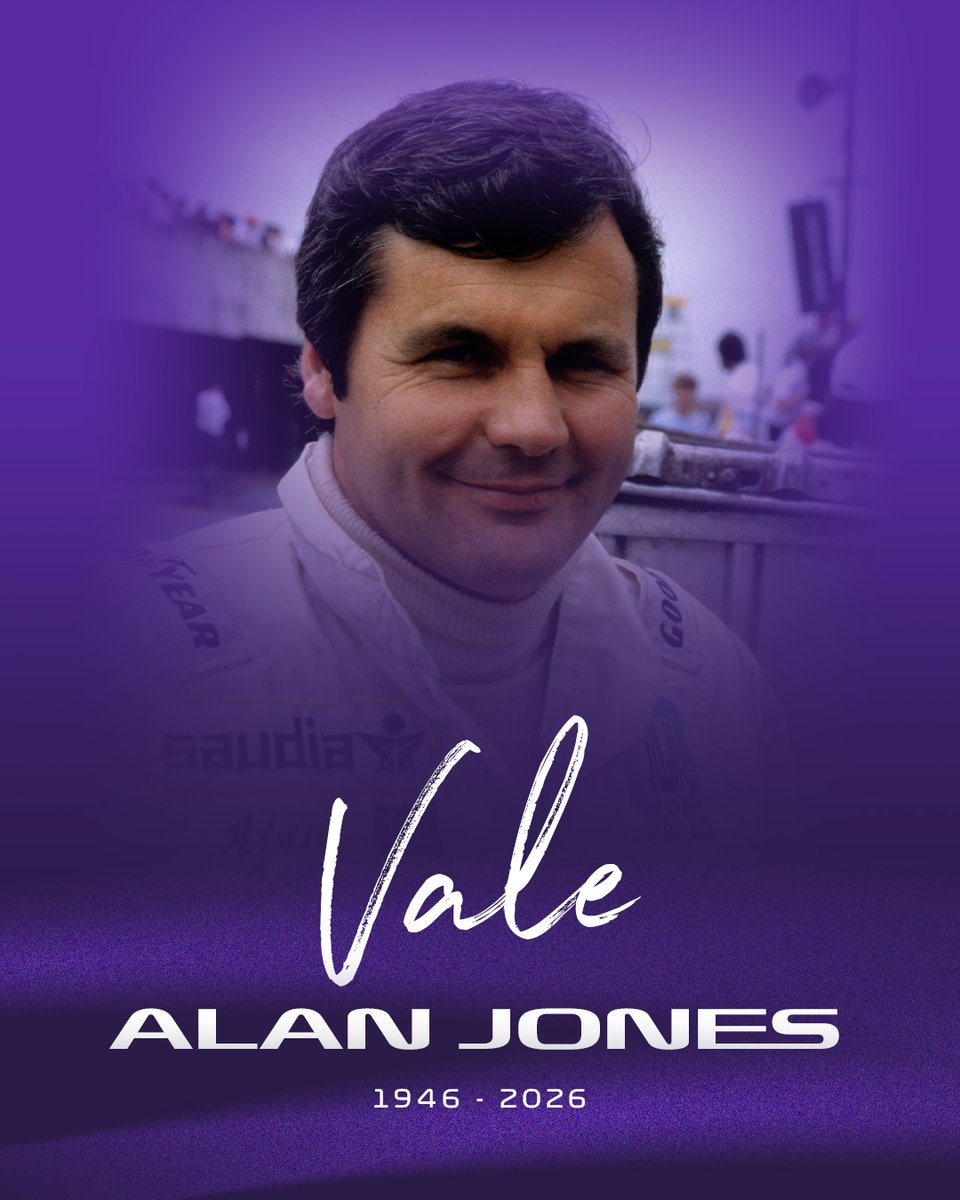
Alan Jones, the Australian who delivered Williams its first Formula 1 drivers' world championship and became one of the defining figures in the team's history, has died aged 80.
Jones passed away on Thursday, 5 November, following a short illness, just three days after celebrating his birthday.
He became only the second Australian to win the Formula 1 world title when he secured the 1980 championship, following in the footsteps of compatriot Jack Brabham. He remains Australia's last drivers' champion.
His success also marked the beginning of a remarkable period for Williams, with Jones becoming the first of the British team's seven world champions.
Jones was remembered as a tough, uncompromising competitor, a personality who fitted the vision of team founder Frank Williams as he sought to establish his outfit among Formula One's leading forces.
Alan Jones and the making of Williams
Born in Melbourne on 2 November 1946, Jones was the son of Australian racing driver Stan Jones. He moved to Europe to pursue a career in motorsport, making his Formula 1 debut with Hesketh at the 1975 Spanish Grand Prix.
His first victory came with Shadow at the 1977 Austrian Grand Prix, but his career reached another level after joining Williams in 1978.
Jones won four races in 1979 and finished third in the championship, laying the foundations for a title challenge the following year.
The 1980 season proved the defining campaign of his career. Driving the Williams FW07B, Jones won five Grands Prix in Argentina, France, Britain, Canada and the United States to secure the drivers' championship ahead of Brazilian Nelson Piquet.
 F1 Australian Grand Prix@ausgrandprix
It is with great sadness that the Australian Grand Prix Corporation acknowledges the passing of Alan Jones, and we extend our deepest sympathies to his family, loved ones and friends.
As a Formula 1® World Champion and one of Australia’s greatest racing
It was Williams' first drivers' title and the beginning of a run that would establish the team as one of the sport's most successful constructors.
Jones added two more victories in 1981, finishing third in the championship before initially stepping away from Formula One at the end of the season.
The uncompromising character behind the success
Jones was not a driver who needed much encouragement from the pit wall. His determination and forceful personality were central to the reputation he developed during his career.
Frank Williams, who died in 2021, admired that independence and described the Australian as a bullish character who needed no hand-holding.
"He never needed propping up mentally, because he was a very determined and bullish character," Williams said, according to Formula One's official website.
"He didn't need any babysitting or hand-holding and that's the way it should be. It shouldn't be necessary for me to ask a driver if he is happy, or if he needs his underwear changed."
That temperament made Jones a natural fit for a team being built around ambition, resilience and an uncompromising approach to competition.
His Formula 1 record included 12 race victories, 24 podium finishes and six pole positions across a career that spanned 116 starts.
Alan Jones remained part of motorsport after F1
Jones' relationship with Formula 1 did not end with his initial retirement. He made a one-off appearance for Arrows in 1983 before returning more regularly with the Beatrice-backed Haas team in 1985.
The comeback did not reproduce the success of his Williams years, and he retired from Formula One after the 1986 season.
He continued competing in Australian motorsport, including touring car and endurance racing. His achievements included winning the 1982 Australian Sports Sedan and GT Championship and the 1993 Bathurst 12 Hour.
Jones retired from competitive racing in 2002 and became a familiar voice on Australian television as a motorsport commentator, where his direct opinions and experience kept him connected to the sport.
His family announced his death through Motorsport Australia, with his wife Amanda Butler-Davis paying tribute to his achievements and personality.
"Alan dedicated his life to motorsport, building a legacy that will live on through the countless people he touched along the way," she said.
"Through his achievements, passion and unmistakable character, both on and off the track, Alan left an enduring mark on the sport both nationally and across the globe."
More than four decades after his championship season, Jones remains a landmark figure in Australian Formula One history and the driver who helped Williams take its first step towards becoming a world championship-winning institution.


