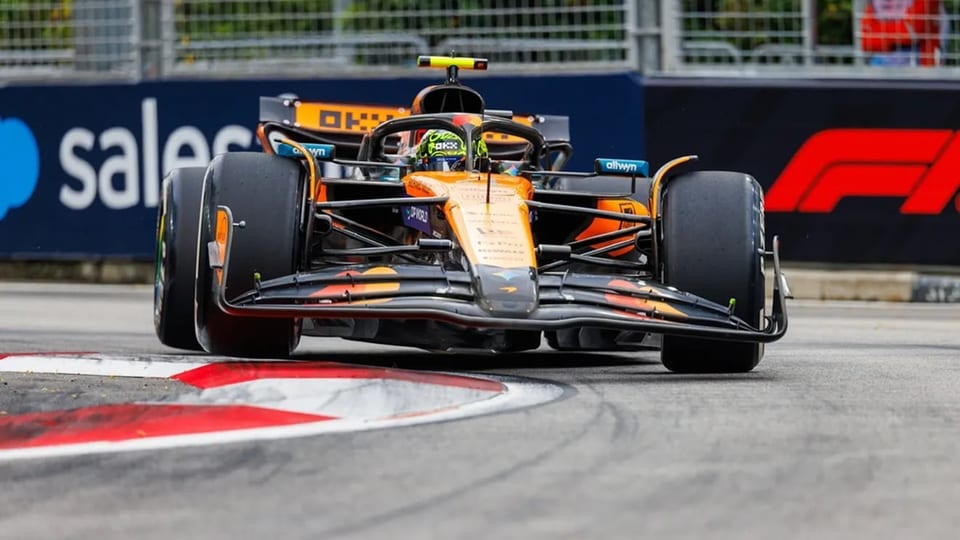
Formula 1 will use the emergency power-unit software configuration introduced at Sepang if wet weather threatens this weekend’s Singapore Grand Prix, following an investigation into the power-loss problems that disrupted the start of the Bahrain Grand Prix in Malaysia.
The FIA confirmed on Thursday that the issue arose when some cars running at low engine speeds experienced a greater loss of power than intended in certain sectors of the circuit.
The governing body will introduce a further wet-weather software update at the United States Grand Prix on 25 October.

The decision comes after heavy rain at Sepang forced officials to suspend the start procedure, with several cars struggling to accelerate during formation laps. Max Verstappen went on to win the race after the revised configuration was installed.
FIA identifies cause of Sepang software failure
The FIA’s investigation found that some cars suffered an excessive and unrecoverable loss of power in sectors where a 250kW reduction was applied under the wet-weather settings.
The governing body said the configuration introduced at Sepang would be reinstated for Singapore if similar weather conditions were expected. It also committed to strengthening software testing and validation in collaboration with teams and power-unit manufacturers.
The review followed an unusual sequence of events at Sepang. The start procedure was suspended at 3.45pm local time, and the cause of the problem was identified within five minutes, according to the FIA’s chronology.
Teams received technical guidance on installing and operating the revised configuration at 4.03pm. The integration process was completed by 4.20pm, and the cars returned to the pit lane at 4.33pm.
The FIA also clarified that the software had undergone testing before its implementation. Teams and power-unit manufacturers conducted simulations, followed by full-scale running during Friday practice at the Belgian and Dutch Grands Prix.
However, the review recommended further measures to make the software more robust, including stronger verification procedures and independent assessment.
Verstappen calls for simpler F1 systems
Verstappen, who won at Sepang, hopes the next generation of regulations will make the cars less dependent on complex software systems.
“The problem is that, as you can see, there is all the software in the background that can make you not pull away or there is a glitch, or even on slow laps, stuff that can happen,” the Red Bull driver said.
“You shouldn't be thinking about where to be having to lift off or going down a gear to make sure that you have better deployment, all these kinds of things.
“That's not what racing should be about. You should be able to go out, have a brake pedal and a throttle pedal, and that's what decides the lap time.”
Cadillac driver Sergio Perez also stressed the need to learn from the incident.
“It's something that we need to learn from and make sure it doesn't happen again,” he said.


Drivers are expected to discuss the issue with the FIA during the Singapore weekend, where the first sprint race at the Marina Bay circuit will take place on Saturday before Sunday’s Grand Prix under the floodlights.
Heat hazard adds to Singapore challenge
The FIA has also declared a heat hazard for the Singapore weekend, with the forecast heat index expected to exceed 31°C.
Teams must fit the components of the approved driver-cooling system, which can include a liquid-cooled vest. Drivers can choose not to wear the cooling garment, but their cars must carry additional ballast under the regulations.
The software issue is a separate challenge from the heat, but both underline the technical and physical demands facing teams as Formula 1 prepares for another demanding weekend.
The immediate priority, however, is ensuring that the power-unit problem exposed by Sepang does not disrupt the Singapore Grand Prix if the weather turns wet.