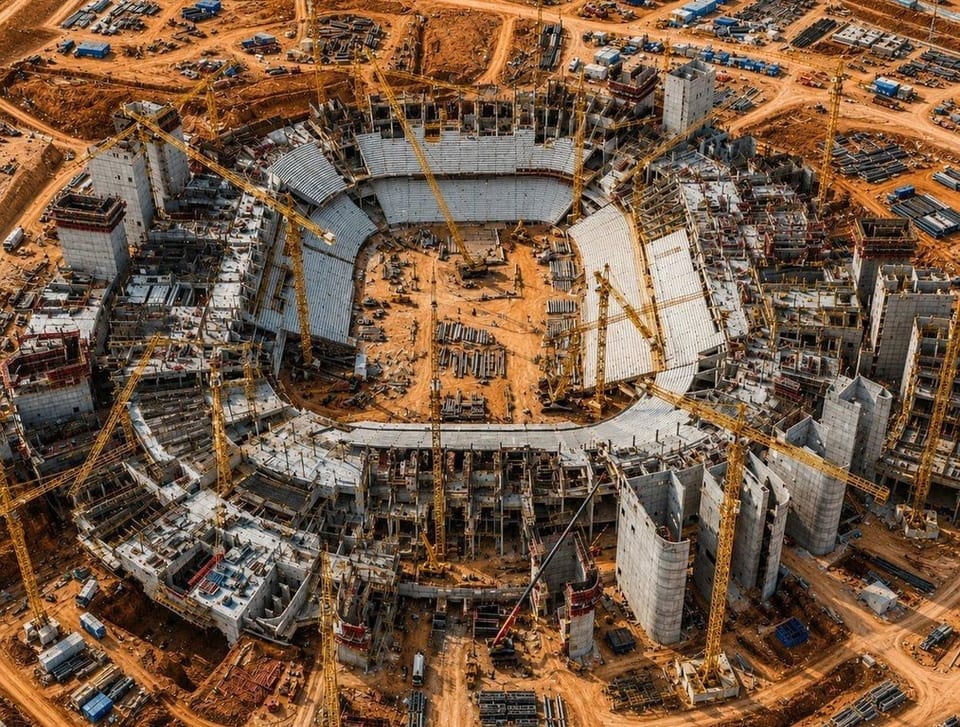

World Cup 2026 venue BMO Field sits at Exhibition Place on the western waterfront of Lake Ontario, two kilometres west of Toronto's financial district.
The stadium opened in 2007 as a football-specific venue for Toronto FC and the FIFA U-20 World Cup, and it has been Canada's primary international football ground ever since.
For World Cup 2026, it operates under the name Toronto Stadium - FIFA's neutral-naming policy - and its capacity expands from approximately 30,000 to 45,736 through the addition of 17,756 temporary seats.
At that configuration, it is the smallest venue in the 2026 World Cup and the only Canadian stadium in the tournament other than BC Place in Vancouver.
Six matches take place here between 12 June and 2 July, including five group stage fixtures across four different groups and one Round of 32 on 2 July.
Canada's opening match on 12 June against Bosnia and Herzegovina is the first men's World Cup fixture ever played in Toronto - Canada's third World Cup appearance after 1986 and 2022, and their first on home soil.
The renovation programme that prepared the stadium cost C$157.9 million in total: C$132.9 million from the City of Toronto and C$25 million from MLSE (Maple Leaf Sports and Entertainment), which owns both Toronto FC and the Toronto Argonauts and manages the stadium on behalf of the City.
 OFootball @ofootball__
The programme spread across five matches from five different nations - Germany, Ghana, Panama, Senegal and Iraq alongside Canada and Bosnia - makes the Toronto Stadium one of the more varied group stage allocations in the tournament.
The waterfront location, excellent transit connections from Union Station and Exhibition GO Station, and the lakeside setting give the venue a matchday character that few NFL-converted or purpose-built American football stadiums in this tournament can match.
What follows is the complete guide to the stadium, its matches and everything a visitor to this World Cup 2026 venue needs to know.
FIFA name | Toronto Stadium |
Commercial name | BMO Field (FIFA neutral-name policy applies; naming rights held by BMO - Bank of Montreal) |
Capacity | 45,736 (World Cup configuration - 30,000 permanent seats plus 17,756 temporary seats; smallest venue in the 2026 World Cup) |
Matches hosted | 6 (five group stage, one Round of 32) |
Opened | 2007 (FIFA U-20 World Cup and first Toronto FC home; original capacity approximately 20,000) |
Location | 170 Princes' Blvd, Exhibition Place, Toronto - western waterfront of Lake Ontario, 2km west of downtown |
Roof | Open-air - no roof |
Tenants | Toronto FC (MLS), Toronto Argonauts (CFL) |
Owner | City of Toronto; managed by MLSE (Maple Leaf Sports and Entertainment) |
Renovation | C$157.9 million total: C$132.9 million City of Toronto, C$25 million MLSE. Works: upper deck east side expansion, LED videoboards, new dugouts, sound system, rooftop patio and lounge |
World Cup context | Canada's first men's World Cup home match ever; BMO Field hosted the 2007 and 2014 U-20 World Cups; only Canadian venue outside Vancouver |
Toronto Stadium features and history
BMO Field was built on the site of the former Exhibition Stadium - the old multipurpose ground where the Toronto Blue Jays briefly played baseball before the SkyDome opened in 1989.
When the football-specific stadium opened in April 2007, it was one of the first purpose-built soccer stadiums in Canada and the foundation on which Major League Soccer's Toronto FC was built.
The original capacity of approximately 20,000 has been expanded progressively - first to around 30,000 through a major east-stand addition, and now to 45,736 for the World Cup through an additional temporary seating programme. Each expansion has maintained the tight, close-to-the-pitch geometry that makes the stadium one of the loudest and most atmospherically intense football environments in North America for its size.
The renovation completed for the 2026 World Cup concentrated on four areas: the capacity expansion via temporary upper-deck seating at both ends; a new LED videoboard system replacing the previous screens; team dugout improvements and locker room upgrades to meet FIFA standards; and a rooftop patio and lounge added to the east stand. The sound system was also upgraded.
The total investment of C$157.9 million represents, for context, more than three times the C$37 million the City of Toronto originally committed to when hosting was first announced - a figure that grew as FIFA's requirements became clearer and the scope of the temporary infrastructure was defined.
The City's C$132.9 million contribution is the largest single public investment in BMO Field's history.
The stadium sits within Exhibition Place- a 192-acre exhibition and events complex that has hosted events continuously since 1879, including six Olympic games qualifying events during the 2015 Pan American Games and regular concerts, auto shows and trade events throughout the year.
The complex sits on the waterfront beside Lake Ontario, with views south across the lake and east toward the Toronto skyline and the CN Tower. The setting on Canada's largest civic waterfront gives BMO Field a location quality that no other stadium in this tournament - however large or technologically advanced - can replicate.
A summer evening match at this venue, with the lake behind and the city skyline visible above the stands, is a matchday experience specific to Toronto.
 SHABZ @DerrickShabz
Canada's home opener and the group stage programme at BMO Field
Canada vs Bosnia and Herzegovina on 12 June is not simply a group stage match. It is the first men's World Cup fixture ever played on Canadian soil in Toronto, and the second match of the entire 2026 tournament — kicked off a few hours after Mexico's opener against South Africa in Mexico City.
Canada qualified for their third World Cup (1986, 2022, 2026) under Jesse Marsch and arrive at this match having spent two years under his management building toward exactly this moment: an opener at home, in Toronto, in a group they are expected to advance from.
The atmosphere at BMO Field for that opening whistle, with a sold-out crowd of 45,736, will be the loudest sporting occasion in Canadian football history.
Germany vs Ivory Coast on 20 June brings two of Europe's and Africa's most historically significant football nations to Toronto in a Group E fixture with direct implications for the group's final shape.
Ghana vs Panama (17 June) and Panama vs Croatia (23 June) give Group L two fixtures at this venue, with Ghana's Afrobeats-influenced travelling support and Panama's Central American contingent making both matches significantly louder than the headline rankings might suggest.
Senegal vs Iraq on 26 June closes the group stage at this venue - a Group I match that brings Sadio Mane and one of Africa's strongest squads to Toronto for what is among the tournament's last group stage decisions.
Matches at Toronto Stadium
Date | Match | Round | Group |
12 June | Canada vs Bosnia and Herzegovina | Group stage | Group B |
17 June | Ghana vs Panama | Group stage | Group L |
20 June | Germany vs Ivory Coast | Group stage | Group E |
23 June | Panama vs Croatia | Group stage | Group L |
26 June | Senegal vs Iraq | Group stage | Group I |
2 July | TBC | Round of 32 | Knockout |
Getting to BMO Field
BMO Field has among the most direct transit connections of any World Cup 2026 venue. The TTC 509 Harbourfront streetcar and 511 Bathurst streetcar both terminate at Exhibition Loop, which is directly at the stadium's main entrance - step off the streetcar and the gates are in front of you. No walking through car parks, no complex wayfinding.
The 509 runs from Union Station's Bay Street streetcar stop to Exhibition Loop in approximately 10 minutes and operates with enhanced frequency on World Cup match days. From Union Station, a route 504 King or 306 King Night streetcar to the 509 connection also works efficiently. TTC fare is C$3.30 for a single-ride token or Presto card tap.
GO Transit has confirmed enhanced service for all six match days, with Exhibition GO Station immediately adjacent to both BMO Field and the official FIFA Fan Festival site at Fort York and The Bentway.
 vogue & velocity @vogueanvelocity
Bosnia-Herzegovina fans start their March towards BMO Field in Toronto
Bosnia are also creating a brilliant atmosphere as they head towards the stadium ahead of the game
Bosnia VS Canada
What a game this is going to be
#fifaworldcup #worldcup
Exhibition GO Station is served by GO Train and GO Bus from across the Greater Toronto Area - Mississauga, Oakville, Brampton, Hamilton and Burlington fans can travel directly without entering the city's downtown core.
From Pearson International Airport, the UP Express to Union Station (25 minutes, C$12.35) connects to the TTC streetcar network. The walk from Union Station to the stadium is approximately 2.7 kilometres - 30 to 35 minutes on foot along the waterfront path, which is a pleasant route in June weather but longer than the 20 minutes the original suggests.
Driving and parking near Exhibition Place is heavily restricted on match days; the TTC and GO Transit combination is the unambiguous recommendation from the City of Toronto and FIFA