

The Springboks and All Blacks have played 114 Tests across 105 years, and New Zealand still hold the overall advantage.
The All Blacks have won 64 times to South Africa's 46, with four draws. But that familiar-looking record needs some context.
Before the 2026 series, New Zealand led 63-43, meaning South Africa's 3-1 victory on the Rugby's Greatest Rivalry tour cut two wins from the historical gap in four Tests.
New Zealand still lead the head-to-head record. The direction of the rivalry, however, has become considerably harder to read than it was a few years ago.
The 2026 series changed the Springboks vs All Blacks record
New Zealand began the latest chapter by winning 33-16 at Ellis Park on 22 August, ending South Africa's run of 12 consecutive victories against other opponents.
The Springboks then won three straight.
They edged the All Blacks 33-26 in Cape Town, with Cheslin Kolbe contributing 18 points, before winning 29-24 at FNB Stadium in front of 85,500 spectators.
South Africa then completed the series with a 43-28 victory in Baltimore.
The fourth Test was the first time the rivalry had been taken to the United States, while the four-Test series was also a first in the professional era.
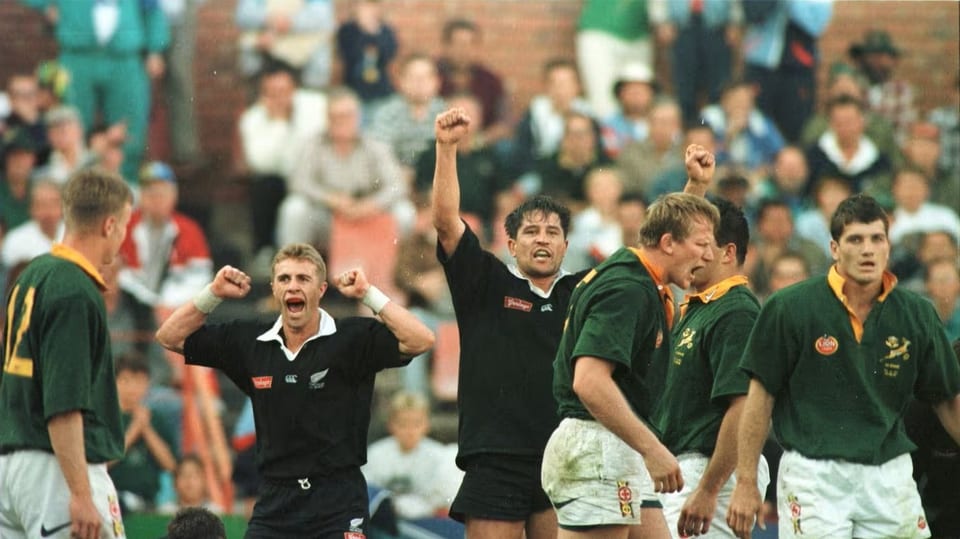
The tour marked New Zealand's first full visit to South Africa since 1996, when Sean Fitzpatrick's All Blacks became the first New Zealand team to win a Test series there.
South Africa's FNB Stadium victory was also their first at the venue in three attempts and only their third win in 11 meetings with New Zealand at altitude.
The Baltimore result then completed a series that had begun with New Zealand holding a 64-43-4 historical advantage.
A rivalry built on tiny margins and huge results
The first meeting came in 1921, when South Africa toured New Zealand. The series finished 1-1 with one draw.
The return series in 1928 was also drawn, but it produced the All Blacks' first Test victory on South African soil. New Zealand won 7-6 at Ellis Park after Archie Strang kicked a late drop goal.
That one-point margin has an echo in the modern rivalry. In 2023, South Africa beat New Zealand 12-11 in the Rugby World Cup final in Paris.
The Springboks had also won the first World Cup final between the sides, beating the All Blacks 15-12 after extra time at Ellis Park in 1995.
Those are the only two World Cup finals between the teams, and both have gone to South Africa.
Between them, the Springboks and All Blacks have won seven of the 10 World Cups contested since 1987. New Zealand won in 1987, 2011 and 2015, while South Africa have claimed four titles, in 1995, 2007, 2019 and 2023. South Africa did not enter the first two tournaments.
The biggest scores tell another story
The All Blacks have twice scored 57 points against South Africa.
They won 57-15 in Durban in 2016, scoring a rivalry-record nine tries, before producing the fixture's biggest winning margin a year later with a 57-0 victory in Albany.
South Africa's highest score is 46, from the extraordinary 46-40 victory at Ellis Park in 2000. The Springboks scored six tries that day, and both their 46 points and six tries remain rivalry records.
Then came Wellington in 2025.
South Africa beat New Zealand 43-10, scoring 36 unanswered points in the second half. The 33-point margin was not simply the Springboks' biggest win over the All Blacks. It became New Zealand's heaviest defeat in Test history.
That result also provided a useful reminder of how quickly the rivalry can turn. New Zealand had beaten South Africa the previous week at Eden Park.
Carter still owns the points record
The individual numbers belong largely to New Zealand's great goal-kickers.
Dan Carter scored 255 points in 21 Tests against South Africa, the most by any player in the rivalry. Andrew Mehrtens is second with 209 from 18 appearances, while Beauden Barrett has 107 from 26.
The overall Springboks vs All Blacks record, though, remains the number that defines the rivalry.
After 114 Tests, New Zealand lead 64-46, with four draws.
The All Blacks have therefore won 18 more matches than South Africa across the century-old fixture. But that gap stood at 20 before the 2026 series.
One tour has not rewritten 105 years of history.
It has, however, changed the numbers enough to make the next chapter look different.


